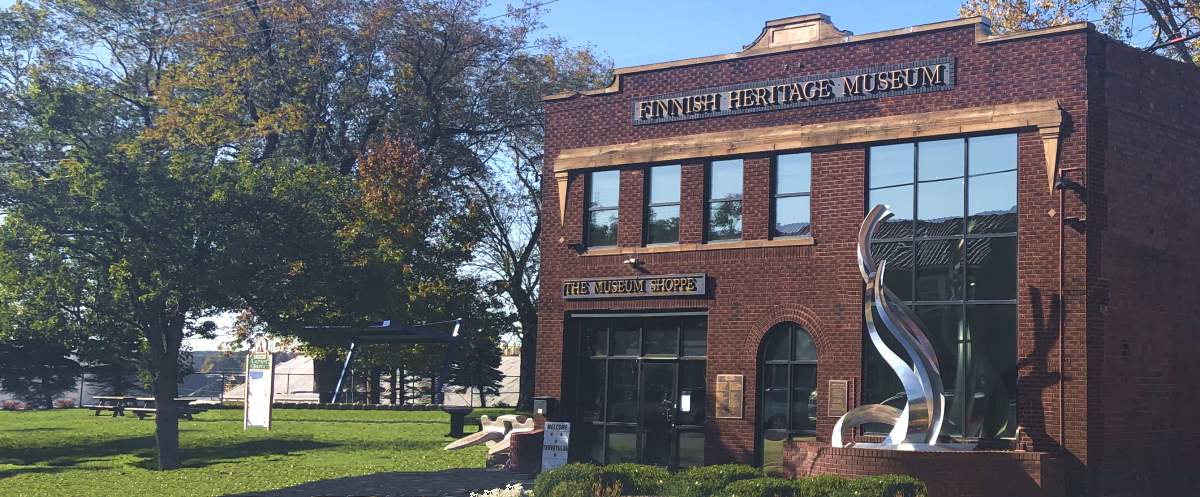
Saturday 10am-3pm
Wednesday 11am-3pm


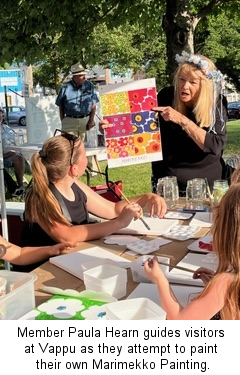
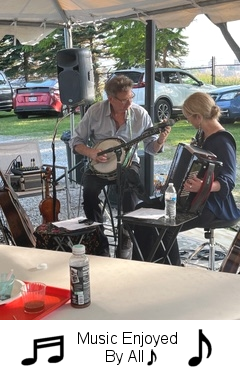
Summer in the Midwest is always crammed full with events to take advantage of the short season with beautiful weather. This year, the museum was no exception. Early in June we celebrated our second annual Vappu, our Springfest, along with the community’s First Friday celebration. Those who are members and their families and friends were treated to some Finnish delicacies as a culture’s food is a great way to get to know the people. After that all who came were treated to an evening of music, a peak at the ideation of an emerging new site for the museum, and some activities such as painting some Marimekko designs and digging for gold. The Penttila family organized this fun day for the second year in a row. We received several new memberships as part of this great outreach day and hopefully many who attended enjoyed great conversation, food, and renewed friendships as well as old. Attendees were encouraged to share stories, songs, etc. with the others during a few breaks from the music.
But June was not over yet as Juhannus was right around the corner. This mid-summer celebration has been held at the local Lake Metroparks’ Fairport Harbor Beach complete with members bringing family and friends, sharing a meal brought by them, and enjoying Kahvia and dessert provided by the museum. Once again, music was organized for the event as well as a bonfire prepared. Unfortunately, our midwest weather did not cooperate and we had to move to the church parlor but we still enjoyed a great evening. We are hoping to not let that bonfire go to waste and reschedule it for October.
On July 19, we celebrated Immigration Stories as we have done for the past many years. Our Program Director asks one of our members who has immigrated from Finland to the United States to share his/her story. This year we were treated to an old love story by Anja. Pull up a chair and read this lovely story of resilience, SISU, and love.
Eerik was born in 1929 in Ahjarvi of Kivennapa borough, to a farmer who owned one of the fastest harness race horses in Finland. Years went by in peace until 1939. On November 30, 1939, the first shots of the war were heard as shootings and bombings and planes flying over their home began. The family got orders to leave the farm immediately. The farmer had time to bury prizes from his race horse but the horse, Viuhka, had to be given to the military. The family except the farmer were relocated somewhere in western Finland, but the father was hospitalized with a stroke. He was sent from the hospital to other relatives closer to Oulu. At the end of the Winter War, the mother, the son and his sister were allowed to return to Ahjarvi. They led a somewhat peaceful life farming and in return for some provisions from the army they put up some soldiers. But the peace would not last as on June 25, 1941, the war broke out again. Eerik was drafted to carry mail either walking or riding his bike. As the war front advanced, the family had to move. Eventually they ended up in Kotka with relatives. Eerik got a job at Vaaramaa auto repair shop. At night he attended high school night classes.
Eerik’s mother’s relatives had migrated to the States and suggested that he come to live with them. In 1948 Eerik left for the States and he did not know English. He did know German, so a Jewish boy in his classes would translate from German to English to answer the teacher. Many disruptions were going on in Finland including a lack of confirmation instruction. After Eerik joined a Finnish Lutheran church in New York, the pastor suggested that Eerik enroll in seminary that had some Finnish-American students and a professor from Viipuri, Finland. So, after only having been in the United States for two years, Eerik was accepted to Seminary. Since his English skills were not strong, he decided to take a year off to improve his competency in English. He lived in the church basement of a pastor in Detroit and worked at one of the automobile factories to earn a living. His family did not care for his career choice and so he found himself alone. To pass some of the time and to deal with his lonelinesss, he started to describe his feelings through poetry. After less than a year, he returned to Seminary, where he successfully completed his studies. He worked as an orderly in a hospital at night, attended classes and lectured during the day, studying whenever he could. Upon finishing the seminary, he had been in the United States for five years and could apply for citizenship. His last name, Vanhatalo, was difficult for others and even his paycheck in the past was written to the wrong name - Van Hatalo. With no proof of his name, he decided he would keep his initials, but find a more suitable name for his new life. He took a Springfield, Illinois, phonebook, scrolled down and found the name Vincent, which could be translated into conqueror or winner. Upon receipt of his citizenship papers, Eerik Johannes Vanhatalo was now Erik John Vincent. As an ordained minister Erik was called to serve Finnish American churches that were bilingual.
While Erik was forging his life path, an elementary school principal’s daughter in Forssa, left home for normal school, a teachers’ college of Early Childhood Education in Helsinki. She was hired right after graduation by the city of Kotka. She had always been active in Christian student and church youth groups and she continued while in Kotka. One day she received a letter through her apartment door mail slot from the USA. The writer mentioned that he had gotten her name from his sister who lived in Kotka. The two began corresponding. It was clear that these two were destined for marriage. God’s plan was for Anja to fly to the US rather than to Formosa as a young missionary. First, they must get married. Erik flew back to the US and Anja had to stay in Forssa to complete all the required paperwork and wait for permission to emigrate. In October of 1960 Anja boarded the plane to New York. Her belongings would arrive on a cargo ship. They spent their first nights in New Jersey and then to Chatham, Michigan, only stopping in Thompson, OH to see Pastor Harold Kallio. The two settled in Chatham for Erik’s first appointment but just as things started to settle down, a call to serve a church in Port Arthur (present day Thunder Bay) arrived. Oh, what to do? Anja only had a green card and she needed to know what would happen with immigration. The application was completed and the rest was left to God. Anja was allowed to take the citizenship exam and swear her allegiance to the United States. God must surely want them in Port Arthur. Over the years Erik was called to other churches. Anja was separated from Erik as he left for Minneapolis and she stayed behind in Canada with their children. Heartbreak fell upon the couple as their 2 1/2 year old second child passed away while they were in Canada. In the fall of 1970 Immanuel Lutheran Church in Fairport Harbor sent a letter to Erik. Erik had finished his studies and they felt God’s work behind them. Anja needed to return to Illinois to complete her job.
The two had many separations due to work and they were called to many churches to serve, but always they returned to one another. Erik worked on a radio spot recording Elaman Sana (Word of Life). He recorded Lutheran Hour programs and meanwhile Anja worked at several early childhood programs. In 2001 their second son passed away unexpectedly. And on Epiphany 2007 Erik was called home. Anja lovingly calls these times The Tale of Two Transplants.
On August 9th, the museum celebrated the 81st birthday of Tove Jansson and the Moomins and on August 30th, the museum returned to the Cleveland Cultural Gardens where members participated in sharing their knowledge of Finland with the other cultures in the gardens. This is a yearly event called One World Day and starts off with a parade